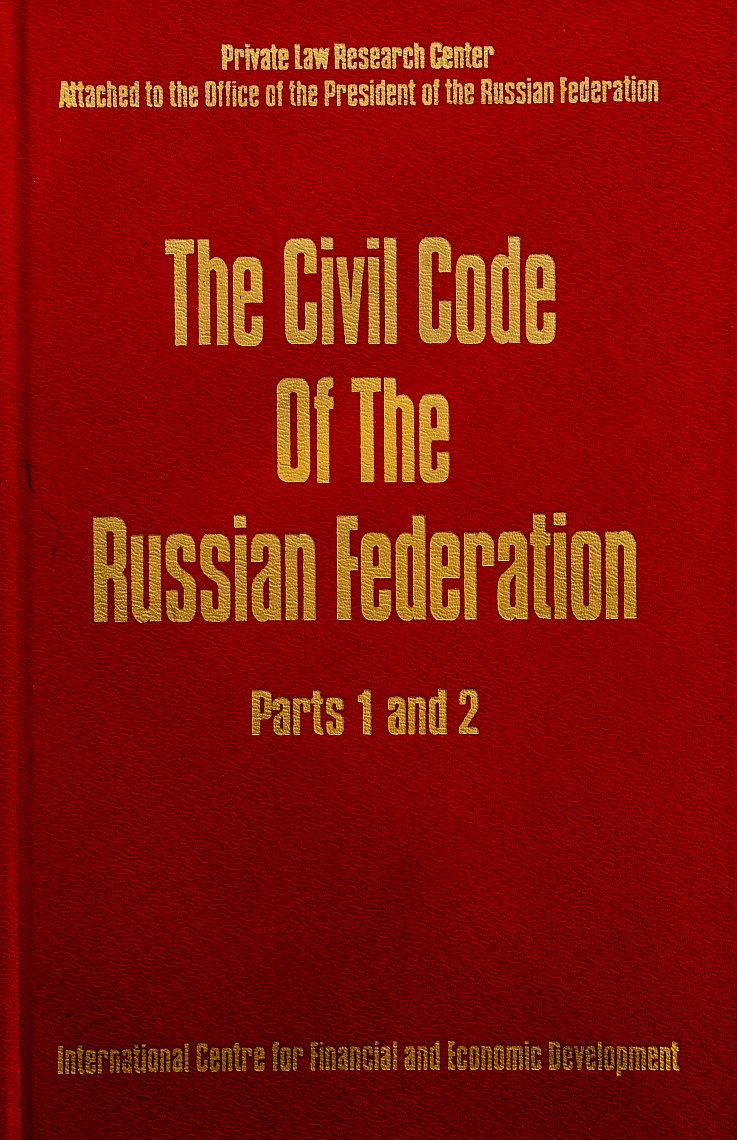
Гражданский кодекс Российской Федерации. Часть 1 и 2 (The Civil Code Of The Russian Federation. Part 1 and 2)
PREFACE TO THE ENGLISH
TRANSLATION OF THE CIVIL
CODE
by A. L. Makovsky
The new Russian Civil Code is presented here to the reader in a
superb translation by Professor Peter Maggs. The Code itself needs,
and indeed deserves, some explanation.
The first part of the Code (Divisions I-III) was adopted by the
lower house of the Russian Parliament—the State Duma—on October 21, 1994; was signed by the President of Russia on November
30.1994, and went into effect on January 1, 1995.1 The Second Part
of the Code (Division 4) was passed by the State Duma on December
22.1995, signed by the President on January 26, 1996, and put into
effect on March 1, 1996.2
The new Civil Code has fully come to life. It is applied everywhere and, in particular, it is constantly being applied by the courts.
Russia’s highest judicial bodies—the Supremfe Court and the High
1 -The text of the first part of the Code and of the simultaneously enacted
Federal Statute on putting the Code into effect was officially published
in the Collection of Legislation of the Russian Federation [Sobranie
zakonodatelstva Rossiiskoi Federatsii], 1994, No. 32, items 3301 and
3302. Chapter 4 of the Code (“Legal Persons”) took effect from the day
of first official publication of the Code in the Russian Gazette [Rossiiskaiagazeta], i.e., from December 8,1994, while the implementation of Chapter 17 of the Code (“Right of Ownership and Other Rights in Things
to Land”) was postponed by the State Duma until the effective date of a
new Russian Land Code. A Land Code was passed by the Duma, but
was rejected by the upper house—the Federation Council.
2 -The text of the Second Part of the Code and of the simultaneously enacted Federal Statue on putting it into effect were officially published in Collection of Legislation of the Russian Federation [Sobranie
zakonodatelstva Rossiiskoi Federatsii], 1996, No. 5, items 410 and
411.
Commercial [Arbitrazhnyi] Court—using the right granted to them
in the Russian Constitution, “to give explanations on questions of
judicial practice” (Articles 126 and 127 of the Constitution), issued
on July 1, 1996, a detailed joint decision on the application of the
First Part of the Code.3 It is not merely specialists in Civil Law that
are writing about the Code; references to Code articles are everywhere in the business-oriented press.
Like every major, truly important statute, the Civil Code occasions both praise and criticism. The phrase “economic constitution”
regularly has been applied to it. The President of Russia has vetoed a
number of Federal statutes because of their inconsistency with the
Code. Very positive evaluations of the Code have been made by a
number of eminent Russian statesmen and both Russian and foreign
scholars. But the Code has also encountered rather harsh criticism
from those who spent many years arguing that socialism needs not
civil law but a special “economic law”—some sort of cocktail of
public and private law. Private notaries are angered by the fact that in
the final text of the Code (in distinction from the draft) most transactions with immovables do not require obligatory authentication by a notary. Sometimes proposals come up in the Duma for amendments
to the Code. At the basis of the these proposals is the lobbying of
special interests or echoes of election campaigns. But if the Code
3 -Decision of the Full Bench of the Supreme Court of the Russian Federation and the Full Bench of the High Commercial [Arbitrazhnyi] Court of the Russian Federation of July 1, 1996, No. 6/8, “On Certain Questions Connected With the Application of the First Part of the Civil Code
of the Russian Federation,” published in the Bulletin of the Supreme
Court of the Russian Federation [Biulleten ’ Verkhovnogo Suda Rossiiskoi Federatsii], 1996, No. 9, pp. 1-10, and in the Herald of the High Commercial Court of the Russian Federation [Vestnik Vysshego Arbitrazhnogo Suda Rossiiskoi Federatsii], 1996, No. 9 (46), pp. 5-20.
4 -Amendments have been made to Articles 64, 185, and 855 of the Code.
The amendment to Paragraph 1 of Article 64, adopted not long before
scheduled elections of deputies to the State Duma, had the purpose of
making citizen-depositors of “shaky” banks creditors of the first priority. The expertise of the authors of the amendment was such that they
turned all citizen-creditors of a bank undergoing liquidation into creditors of the first priority. Similar criticisms may be made with respect to
the amendments to Articles 185 and 855 of the Civil Code.
causes difficulties for some, this is also evidence of its vitality and
effectiveness.
From the start of real work on the Code in the spring of 1992,
until the adoption of the Second Part of the Code in December 1995
over four years passed. This is an extraordinary event in modem history, when a code of such importance and size (the first two parts of
the Code contain 1109 articles, most of which are rather lengthy)
was created in such a short time. It is doubtful, however, if necessity
should be considered a virtue.
The economic revolution in Russia, which in historical terms took
place in one moment, instantly transformed most previous legislation into an historical monument. Simultaneously with statutes on
reforms (On Ownership, On Entrepreneurship, etc.), individual “market” statutes on specific matters (On Pledge, On Insurance, etc.) started to be passed. At the same time the “cleanup” of the prior legislation
entirely ceased: the old laws were neither repealed nor amended. As
the result, by the early 1990s, a “layer cake” was formed at the bottom of which still were many legislative acts of the former USSR,
above them, the old legislation of the Russian Soviet Federated Socialist Republic (“RSFSR”) including the 1964 RSFSR Civil Code,
and then the Fundamental Principles of Civil Legislation of the USSR
and the Republics of 1991,5 and finally the “new” (i.e., enacted after
June 12,1990—the date of Russian declaration of sovereignty) legislation of Russia.
This legislative chaos contrasted sharply with the goals of the
economic reforms, for a market economy especially requires stable
and clear laws. In a country with civil law belonging to the legal
family of Continental Europe, with its civil law basically systematized in the middle of the nineteenth century and twice codified in
the twentieth century (1922 and 1964), there was hardly any other
5 -This statute was adopted on May 31, 1991 in the USSR (Gazette of the
Supreme Soviet of the USSR [Vedomosti Verhkhovnogo Soveta SSSR]y
1991, No. 26, item 733), but never went into effect as a USSR statute. It
was put into effect in 1992 on the territory of Russia (Gazette of the
Congress of People s Deputies of the Russian Federation and the Supreme Soviet of the Russian Federation [Vedomosti S”ezda narodnykh
deputatov Rossiiskoi Federatsii I Verkhovnogo Soveta Rossiiskoi Federatsii\y 1992, No. 30, item 1800).
way to impose order than to create a new civil code and a new system
of civil statutes based on it.
The new Civil Code neither repeats nor copies the civil and commercial codes and statutes of other countries. It has its own “personality,” with its own virtues and vices. But the basic features of this
“personality” are noticeable not so much in comparing the Code with
foreign codes as in contrasting it with prior Soviet legislation.
The new language of civil law in Russia can be seen particularly
in the norms of the Code envisioning the free acquisition and exercise of civil-law rights (Articles 1 and 9), freedom of every owner to
exercise its powers (Paragraph 2 of Article 209), the possibility of
private ownership of any kind of property with the exception of that
excluded from commerce (Article 213), freedom of contract (Article
421), and in a number of rules striving to precisely describe the possible limitations on these freedoms (Paragraph 2 of Article 1, Paragraph 2 of Article 235, Paragraph 2 of Article 422, and others), to
establish numerus clausus of such limitations. It is namely these “basic norms” deriving from the 1993 Russian Constitution and the many
concrete rules developing them that are the main legal foundation of
the new Russian society. Some of them appear to be declaratory, but
they are necessary to break clearly with the prior regime of almost
total concentration of all productive property in the hands of the state
and the obligatory conformity of all important contracts in the economy to the planning commands of state agencies.
A feature of the new Code that is important and also clearly visible to the Russian jurist is the introduction into civil commerce of
such objects as land, enterprises, apartments, commercial paper, and
securities as well as the corresponding regulation of this commerce
in the Code (Articles 129, 132, 209, etc.; Chapters 7, 17, 18, §§ 7-8
of Chapter 30, §§ 4-5 of Chapter 34, and Chapter 35). These objects
were either entirely excluded from free civil commerce and given by
the state only for use (land, apartments in state buildings), or were
distributed mainly within the state sector of the economy on the basis
of administrative orders (enterprises, structures, etc.), or were used
only in the area of foreign trade and state loans (commercial paper
and securities).
The problem of dualism of private law was decided in the new
Civil Code in accordance with the long-standing theory and legislalive tradition of Russian civil law and the tendency of development
of civil law in a number of other countries (Switzerland, Italy, the
Netherlands). The Code in principle contains rules identical both for
entrepreneurs and for other participants in civil commerce. It suffices to say that of twenty-six contracts regulated in Division IV of the Code (with their numerous variants), only one (franchising) can be
called entrepreneurial in the full sense of the word (See Article 1027)
and only one (gift) may not be concluded between commercial organizations (Article 575), although, of course, many of these twentysix types of contracts (supply, construction work, carriage of freight,
etc.) are meant primarily for relations among entrepreneurs. The Code
does contain a number of special rules for those who engage in entrepreneurial activity. These rules are primarily connected with the professional nature of this activity (See Article 310, Paragraph 4 of Article 358, Paragraph 3 of Article 401, Articles 469, 481, 721, 891, etc.). With the adoption of the new Civil Code, the idea of creating
along with it of a Russian Commercial (or Entrepreneurial) Code
became irrelevant.
Being a Federal statute of a country whose Constitution puts civil
legislation in the exclusive competence of the Federation (Paragraph
“o” of Article 71), the Civil Code substantially strengthens the role
of statute law in regulating the relations that are the subject of the
Code. In the first place the volume of the adopted parts of the Code is
twice as large as the whole 1964 Civil Code. In the second place, the
Code specifically states that other civil law statutes, and also norms
of civil law contained in other statutes must correspond to the Code
(Paragraph 2 of Article 3). In the third place, in a very large number
of cases, when the Civil Code allows the establishment of exceptions
to its rules, it allows this to be done only by a statute, not by edicts of
the President nor by decrees of the Government. Finally, in the fourth
place, the Code, for the first time in the history of our law, tries to
predetermine (so to speak to “build in outline”) the whole system of
civil legislation.
The Code gives the court a more independent, more active role in
the application of its norms, going far beyond the limits of the mere
following of the letter of the law.
The Code directly provides two very important means of deciding disputes in civil cases when the respective relationship is not regulated by law, agreement of the parties, or the customs of trade:
analogy of statute, i.e. the application by the court of legislation regulating similar relations (Paragraph 1 of Article 6) and analogy of law, i.e. the decision of the dispute proceeding “from the general
principles and sense of civil legislation” if it is impossible to use
analogy of statute (Paragraph 2 of Article 6). In many situations, the
application of the rules of the Code depends upon the extent to which
one rule or another established in the Code corresponds to the “nature” of the concrete relations, despite the fact that by the letter of the law, there is no doubt about the subordination of such relations to
this rule (see, for instance, Paragraph 2 of Article 467, Paragraph 2
of Article 479, Paragraph 3 of Article 480, Paragraph 1 of Article
481, Paragraph 1 of Article 482, etc.) The Code provides a significantly greater freedom in deciding disputes for judicial discretion
also by the way that in many norms it uses concepts and criteria whose
content may be defined only by a court considering all the circumstances of a concrete case. These are such concepts as “substantial
breach of contract,” “reasonable time,” “disproportion of the penalty
to the damages,” “necessary expenses,” and many others.
In conclusion a few words should be said about those who prepared the draft of the Code and about the one who has made this
English translation of the Code.
Over fifty Russian jurists took part in the creation of the First and
Second Parts of the Civil Code. But the basic burden of this work, in
particular on the First Part of the Code, was borne by a small group
of civil law specialists united under the aegis of the Private Law Research Center Attached to the Office of the President of the Russian
Federation, at the initiative of Corresponding Member of the Russian Academy of Sciences S.S. Alekseev. This group included one of
the most experienced “law drafters,” former Deputy Minister of Justice of the USSR, G.D. Golubov, some of the best known civil law
specialists of our country, Professors МЛ. Braginsky, V.A. Dozortsev, A.S. Komarov, M,G. Rozenberg, and E.A. Sukhanov, Doctor of
Legal Sciences V V Vitriansky, Deputy President of the High Commercial [Arbitriazhnyi] Court of Russia, Dr P.V Krasheninnikov,
Deputy Chairman of the Antimonopoly Committee of Russia, Dr
VP Zvekov, Staff Counsel of the Government of Russia, and the talented young jurists G.E. Avilov and Dr O.M. Kozyr. All work on the draft proceeded in constant and very cordial cooperation with Professor V.F. Yakovlev, President of the High Commercial [Arbitrazhnyi] Court.
Particular mention should be made of two of my friends and colleagues, whom we have lost. At the end of 1996, an exquisite specialist in civil law and an extraordinary person, Dr S.A. Khokhlov,
Executive Director of the Private Law Research Center, Rector of
the Russian Postgraduate School of Private Law, passed away. He
was the “soul” of our Research Center and the most dynamic participant in the creation of the Code. Another very experienced professional was Professor lu.Kh. Kalmykov, not long ago the Chairman of
the Committee on Legislation of the Supreme Soviet of the USSR,
Minister of Justice of Russia, a man who retired from this post when
the war in Chechnya began in 1994. He was one of the initiators of
the development of a new Civil Code and continued work on it until
the last day of his life in January 1997. The loss of these people is
irreplaceable.
The group working on the draft of the Code successfully combined not only three generations of Russian civil law specialists, but
three schools of civil law (Moscow, Petersburg, and Yekaterinburg).
As Professor Bernard Black of Columbia University noted in a letter
to the author of these lines, “I do not know in Russia any other group
of drafters of legislation who would work on such a high professional level.” It remains only to add that this work was based, in the main, on the enthusiasm of its participants.
The person who undertook the heavy task of translation of the
first two parts of the Russian Civil Code into English, Professor Peter B. Maggs of the University of Illinois, was long known worldwide as one of the greatest specialists on Soviet law. For reasons that
hardly need explanation, his numerous books and articles were much
less known in Russia until the end of the Cold War. The lack of mutual interaction in the past has been compensated in recent years by
the close cooperation with Professor Maggs of almost all the wellknown specialists in civil law of Russia and the other countries of the
Commonwealth of Independent States. The development of civil legislation in these countries is to a large extent obligated for its results to his benevolent and highly professional assistance.
It should be said that the entire preparation of the draft Code was accompanied by constant consultation with jurists of other countries, with Robert S. Summers and James J. White (USA), Walter Snijders,
L. Timmerman, Ferdinand J.M. Feldbrugge, Arthur S. Hartkamp, and
William B. Simons (the Netherlands), W. Roland and Peter Schlechtriem (Germany), Joachim M. Bonell and Gabriele Crespi-Reghizzi
(Italy), and many others. Very many of the suggestions and comments were adopted. Nevertheless, as a whole, the Code “is based on
the Russian legal tradition, which was always characterized by an
independent approach to the solution of its civil law problems, developed taking account of the achievements of foreign research in
private law.”
Автор:
Жильцов А.Н. / Маковский А.Л. / и др
Год издания:
1997
Доп. файл:
Гражданский кодекс Российской Федерации. Часть 1 и 2 / Гражданский кодекс Российской Федерации. Часть 1 и 2
Программа:
Исследовательский центр частного права